

Chmura edukacyjna


Kontusze szlacheckie
The noblewoman's headdress is a velvet hat with a fur trim. A noblewoman wears a silk corset on an elegant dress, the skirt of which either stretches over the cornea and covers the feet or reaches the middle of the calf. Sewed by expensive fur, fitted at the waist, flared at the hips, it has - just like the robe - slit sleeves. Shoes worn by a noblewoman are usually dyed yellow or red.
The nobleman wears a tall cap or a cap called a confederate. The hat is made of precious fabric, edged with a fur band, decorated with a quilt of bird feathers and a brooch. He puts on a robe on a patterned silk zupan, fastened from the collar to the waist with a row of small, decorative, expensive buttons. A characteristic feature of the "kontusz", decorated with buttons and loops, are cut sleeves called outlets, sometimes thrown over the back.
The "kontusz" is tied several times with a shiny, long silk belt interspersed with golden thread. He wears wide trousers tucked into shoes made of soft leather, with obliquely cut uppers and upturned toes, dyed yellow or red. The outfit is complemented by an intricately made, decorated with gold and jewels karabela, pinned to the side with a special belt with leather rapids.


Strój Kurpiów z Puszczy Białej
The men’s costume was very modest and devoid of ornamentation. It consisted of a linen shirt, trousers of self-made linen, cotton and wool fabric with vertical stripes or of cloth, and a vest or jacket – the so called letnik. The most important, most expensive and most attractive element of men’s costume was a white or grey-brown sukmana (the outer garment of men), trimmed with black tape. It was girded with w woven belt: red on holidays, and black or navy blue on weekdays. In winter they wore jackets made of black sheepskin, tanned to a light brown colour. They had a simple cut, no fastening and the only decoration was a large, padded collar of black sheep’s fleece. On their feet men wore leather clogs or shoes with uppers. Women’s clothing was more ornate. Scarves were most commonly worn on the head. At the end of the nineteenth century, on holidays, married women wore a cap with so called wings, partly covered with Tibetan kerchief. Girls walked with their heads uncovered, and only on cold days did they wear kerchiefs. Women’s shirts were decorated with embroidery: most often red, sometimes with some highlights made with black thread, and white on wedding shirts. Cuffs and collar were finished with crochet lace. Over the shirt women wore a dress made of woolen homespun with vertical stripes. In different periods the dresses had different colours and decorations. The front was always covered by a delicate checkered or horizontally striped apron. Outer garments in this region were shoulder aprons, large and thick, woolen and kerchiefs, as well as padded coats called angierka. In addition, kaftans (the so-called jackets) were commonly used. Women wore shoes with a small heel laced with a white, red, or pink ribbon. The most desirable jewelry was real beads, usually cylindrical beads with a coin medal or a cross.

Stroje Lachów Sądeckich
The women’s outfit includes a white linen shirt with red or white English embroidery, a dark velvet corset, embroidered with soft colors in the shape of flowers with a wavy stem, a flowing skirt, usually sewn from factory calico, chambray, organdy or fine wool printed in small patterns. Typical here was pink calico, a skirt made of pink calico with a delicate floral pattern, decorated at the bottom with a holy ornament made of black string, often with oak leaves. The outfit of a married woman was slightly different. Instead of a corset, married women wore – “katanka” with long sleeves made of velvet wool or jacquard fabrics embroidered with multi-colored beads. Older women usually wore dark wool skirts of one color, which were covered on the front with long, flowing aprons decorated with sewn-on haberdashery, lace and ribbons. The female attire was complemented by strings of real beads, the number of which testified to the wealth of the owners.
The men's occasional outfit looked fabulous due to the particularly beautiful and masterful decorations. Richly decorated with multi-colored embroidery was a caftan and trousers. The caftan was knee-length and, in addition to embroidery, it was decorated with brass buttons and yarn loops, which were placed at the front and around the waist. Pants were sewn along the so-called buttresses. Characteristic of Lachs - heart-shaped ornaments. White linen shirts were embroidered on the collar, cuffs and bodice. On the occasion of the ceremony, the shirt was tied with a stiffened silk ribbon decorated with sequins and embroidery. Richly decorated with an embossed ornament was a wide highlander-type leather belt studded with brass buttons and rings.


Stroje Krakowiakow Zachodnich
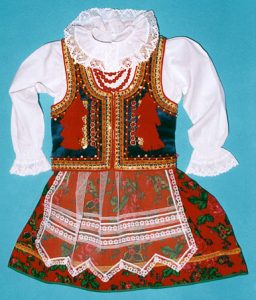
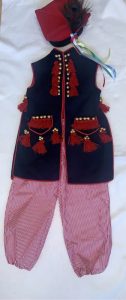
Lass‘s headdress is a wreath of artificial flowers, adorned with colorful ribbons flowing down her back. Over a snow-white shirt decorated with English embroidery, she puts on a velvet corset embroidered with colorful embroidery, adorned with shiny multicolored sequins, beads, ribbons. The outfit is complemented by natural beads, the red of which contrasts beautifully with the white of the shirt.Lad wears a hat - a red cap surrounded by a black lamb and colorful ribbons. Over a white linen shirt decorated with a red ribbon at the neck, he puts on a knee-length sleeveless caftan made of dark cloth with a red lining, trimmed with decorative tassels and buttons. The caftan is tied with a studded leather belt. Decorative plates, called claps, hang on the side of the belt. "Portki", or bright linen pants, with red stripes tucked into high leather boots.

Strój rozbarski (bytomski)


Stylized Cieszyn region costume

Vilnius region winter costumes
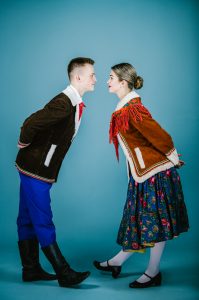
The shirts of Vilnius region costumes are often decorated with perforated or woven patterns of choice, which can be red, blue, or green. The ends of the shirt sleeves are decorated with them, as well as the shoulders and chest areas. The skirts are transverse with longitudinal ridges. For winter costumes the sheepskin coats are obligatory, as well as large scarves to put over one’s shoulders. Men put on blue pants and long leather boots. In addition, they wear a warm sheepskin coat, the bottom of which is embroidered with selected designs. Under the coat a shirt is worn, which is tied with a red ribbon.

Stroj łowicki
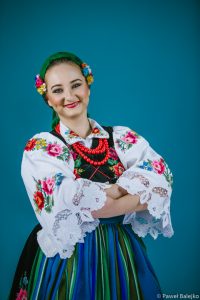
The woman wears a flowery silkworm headscarf and pinned flowers on the sides. The collar and sleeves of the white linen shirt are decorated with colorful embroidery. Woman puts a petticoat over her shirt, which consists of two sewn parts: a velvet bodice decorated with embroidery and a striped, richly gathered skirt with a velvet sewn around the bottom hem. He ties the skirt around the waist with an apron, sewn as in the case of a striped homespun skirt and similarly decorated with a velvet embroidered with colorful flowers. She puts her boots on over white stockings and ties with a colorful ribbon. The man wears a felt hat with a velvet ribbon embroidered with flowers, decorated with sequins and a bunch of flowers. He puts a funnel, a hip-length sleeveless waistcoat sewed with a decorative string, on a linen shirt called "bleacher", the collar and cuffs of which are decorated with multicolored embroidery. He ties a decorative woolen belt on the funnel. If he wears additional outerwear with long sleeves or a suit, then the belt is tied on them. Trousers made of striped woolly wool are tucked into leather boots with uppers.


Stroj rzeszowski
Rzeszowianki nosiły białe koszule z haftami i zdobionymi kołnierzykami. Wkładały spódnice zakrywające kolana – w różnych odcieniach granatu lub zieleni, zdobione u dołu tasiemkami.
Na koszulę zakładano czarny, sznurowany gorset, który był ozdabiany różnokształtnymi i barwnymi cekinami. Na szyi noszono czerwone korale. Przepasywało się białym fartuchem z naszytymi kolorowymi koronkami. Panny nosiły na głowie kolorowe chusty.
Strój męski składał się z płóciennej koszuli i portek zrobionych z sukna, tzw. sukieniaków w kolorze niebieskim. Kawalerowie mieli naszyte na udach trapezowe oblamówki w kolorze czerwonym.
Na koszule zakładano kamizolę. Kamizola (kamizelka) wykonana była z tego samego niebieskiego sukna, co spodnie – sięgała poniżej bioder. Zdobieniem kamizelki były przyszywane wzdłuż guzików małe kolorowe pomponiki, tzw. srokate kocasie. Na wierzch wkładano brązową sukmanę. Rzeszowiacy nosili słomiane kapelusze oraz czarne kapelusze, tzw. makowe



Stroje kujawskie
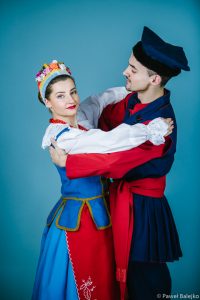
Nakryciem głowy dziewczyny jest szlarka, czyli paski materiału ułożone w harmonijkę i ozdobione sztucznymi kwiatami. Na białą koszulę zakłada ściśle opinający gorset – sznurówkę.
Gorsety takie szyto z wełny, sukna lub aksamitu. Kujawianka ma też na sobie halkę czerwonego koloru, suto marszczoną spódnicę wierzchnią i fartuszek, zwany zapaską. Boki atłasowej lub jedwabnej zapaski – najczęściej czerwonej lub niebieskiej – zdobi biały haft.
Strój dopełniają białe pończochy, odświętne sznurowane trzewiki i czerwone korale. Chłopak ma na głowie obszytą barankiem czapkę rogatywkę. Zakłada krótki uszyty z czerwonego sukna kaftan z długimi rękawami, zwany jaką. Na jakę wkłada katankę, czyli kamizelkę bez rękawów – długą do bioder, szytą z granatowej tkaniny, ozdobioną na piersiach pętlicami, czyli pasmanteryjnymi naszyciami.
Katanę zdobi ponadto czerwony wełniany pas, związany w misterny węzeł. Sukienne niebieskie spodnie nosi chłopak wpuszczone w wysokie skórzane buty iskrzoki podbite podkówkami, z cholewą karbowaną w okolicy kostki.


Lithuanian traditional costume
The traditional costume of Lithuanian women consisted of a shirt, skirt, apron, sleeveless jacket and a belt – krajka. Virgins wore galionas – a headdress or garland with ribbons – on their heads, while married women wore napitki – headwear of draped fabric modelled on oriental turbans. The costumes were richly decorated with embroidery. The outer garments were siermięgi (a coat) or sheepskin coats. Men’s costume lost its national specificity earlier that women’s. It consisted of linen shirt, linen cloth or half-wool trousers, a waistcoat, a linen or cloth kaftan (the so-called jackets), and a felted hat. In winter they wore siermięgi, woollen shrugs, half-sheepskins or sheepskins tanned in white. The traditional footwear was bast shoes or the so-called leather postały, while in the Western parts of Lithuania wooden boots called klumpės. On holidays, leather shoes were worn.
Costumes from the period of Duchy of Warsaw
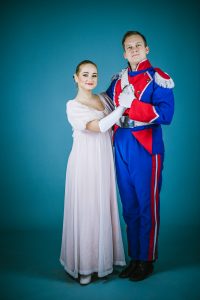
The men’s costume from the Napoleonic wars period refers to the history of Polish army and is presented in a very characteristic way – the presented men’s costume is in fact a replica of the uniform of the light cavalry formation of the Duchy of Warsaw, also called lancer’s costume. It consists of a high, angular cap (also known as the lancer’s cap), the shape of which derives from Polish tradition, e.g. caps called konfederatki, worn by participants of the Bar Confederation. The lancer’s caps were often decorated with feathers or decorative or decorative strings. Another characteristic element of the costume are elegant trousers with stripes and a jacket with decorative epaulettes on the shoulders (so called lancer) in the colors of a particular regiment. Officer’s jackets were additionally decorated with gala ropes. The costume was completed with a white wide belt and leather half-shoes, usually black in color. In company and in rooms, the lancer’s cap is worn on the left shoulder so that the right shoulder can be used to assist and support the partner. Women’s costume from the period of Duchy of Warsaw is presented as a light, airy dress in white or a delicate shade of yellow, pink, or blue. The gown has wide, short sleeves and is belted at the waist with a sash in the color of the gown or in white. The outfit is completed with long gloves reaching beyond the elbow – necessarily in white and low matching shoes in a light colour (also preferably white). The costume is characterized by a modest hairstyle and little jewellery – another reference to the history of the Duchy of Warsaw, when even wealthy people tried to support Napoleon‘s war machine, which was sweeping through Europe at the time and an open display of wealth was considered impolite.

Opoczno region traditional costume
In the twentieth century in the Opoczno region a small head scarf called a stalinówka began to be worn. The maidens pinned to it the herb of rue, daisies or dry flowers. Mob caps were worn with ceremonial attire and only married women wore them. Shirts were initially sewn from self-made linen, with time they began to use cotton linen for this purpose. With the older models, the collars were small and standing, while with the new ones they were larger and lined, and the embroidery has also changed. The dresses differed in colour, and the skirts of the dresses were decorated by hemming the bottom edge and sewing in the middle of the length several rows of narrower or wider velvet. The dress was always belted with a woollen apron, which at the beginning of the twentieth century were wide and long, later much shorter and narrower ones were worn with various types of decorations. Colourful selvedge, with pompons sewn on the ends, were used to tie up the woollen apron. To protect themselves from the cold, women wore shoulder aprons, which were thrown over the head or shoulders and tied with a selvedge on the chest or under the chin. Clogs were used as working shoes, while on special occasions high boots with heels were worn. Older women laced them up with a black shoelace, while younger ones with red, green or pink shoelace. The most commonly worn jewellery was – real or artificial beads and amber, artificial pearls and the so-called dętki – hollow glass beads. Men, depending on the season, wore horned caps, felt hats, and above all maciejówka – round, navy blue or black, caps with a black lacquered peak. The men’s shirt has changed over the years. There were three types of it, which differed in the cut of the collar and the front part. The shirts were sewn from homespun linen and embroidered on the front, collar and cuffs. Lejbik – a simple striped wool vest –which was word from 1890, was put on a shirt. The same year, sukmana – the outer garment of men – appeared. There were several ways of tying the belt, it was girdled several times and then tied leaving two hanging ends. Linen white or black and blue breeches were worn in the summer, and several pairs were worn in cooler weather. On special occasions men wore woollen breeches with folds and their legs were tucked into shoes with uppers.

Stroj krzczonowski (lubelski)
Dziewczyna nosi wianek przybrany wstążkami, młoda mężatka nakrycie głowy zwane humełką, a kobieta dojrzała - chustę. Na białą bawełnianą koszulę, której kołnierzyk i mankiety wyszyte są haftem krzyżykowym, zakłada aksamitny gorset. Zdobią go tasiemki, cekiny, koraliki, posrebrzane nici i koronki. Na szerokiej wełnianej spodnicy, u dołu ozdobionej pasami błyszczących tasiemek, zawiązuje króciutki fartuszek zwany zapaską. Podobnie jak spódnica, zapaska obszyta jest różnobarwnymi tasiemkami, a ponadto koronką. Czarne odświętne trzewiki sznurowane są czerwoną lub zieloną tasiemką. Strój uzupełniają naszyjniki z naturalnych lub sztucznych korali.
Strój Kurpiów z Puszczy Białej
The men’s costume was very modest and devoid of ornamentation. It consisted of a linen shirt, trousers of self-made linen, cotton and wool fabric with vertical stripes or of cloth, and a vest or jacket – the so called letnik. The most important, most expensive and most attractive element of men’s costume was a white or grey-brown sukmana (the outer garment of men), trimmed with black tape. It was girded with w woven belt: red on holidays, and black or navy blue on weekdays. In winter they wore jackets made of black sheepskin, tanned to a light brown colour. They had a simple cut, no fastening and the only decoration was a large, padded collar of black sheep’s fleece. On their feet men wore leather clogs or shoes with uppers. Women’s clothing was more ornate. Scarves were most commonly worn on the head. At the end of the nineteenth century, on holidays, married women wore a cap with so called wings, partly covered with Tibetan kerchief. Girls walked with their heads uncovered, and only on cold days did they wear kerchiefs. Women’s shirts were decorated with embroidery: most often red, sometimes with some highlights made with black thread, and white on wedding shirts. Cuffs and collar were finished with crochet lace. Over the shirt women wore a dress made of woolen homespun with vertical stripes. In different periods the dresses had different colours and decorations. The front was always covered by a delicate checkered or horizontally striped apron. Outer garments in this region were shoulder aprons, large and thick, woolen and kerchiefs, as well as padded coats called angierka. In addition, kaftans (the so-called jackets) were commonly used. Women wore shoes with a small heel laced with a white, red, or pink ribbon. The most desirable jewelry was real beads, usually cylindrical beads with a coin medal or a cross.


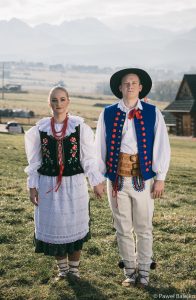


Stroje górali żywieckich
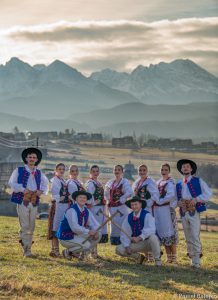
Stroje górali żywieckich zawierają elementy typowe dla strojów górali polskich takie jak: kapota, haftowana koszula, kamizelka oraz kierpce, czyli skórzane lekkie buty. Męski strój ozdobiony jest parzenicami i lampasami.
Mężczyźni opasują się również pasami skórzanymi. Wielkość pasa i jego zdobność dawały niegdyś pojęcie o majętności jego posiadacza. Częstym elementem męskiego stroju jest laska pasterska lub siekiera zwana ciupagą, które służyły niegdyś do obrony. Mężczyzna nosi też zwykle kapelusz z muszelkami lub koralikami chętnie ozdabiany orlim lub sokolim piórem. 
Strój kobiecy składa się z wielowarstwowej spódnicy, pończoch, skarpet wełnianych (zwykle czerwonych lub białych), kierpców, białej haftowanej koszuli oraz kamizelki lub serdaka. Spódnice są zwykle lniane. Ubiera się na nie zapaskę – rodzaj fartucha, ozdobionego w drobne kwiaty.
Na białą koszulę ubiera się serdaki będące najdroższym elementem stroju. Są zdobione cekinami i świecidełkami, wyszywane w typowo góralskie motywy roślinne. Strój dopełniają czerwone korale. Stałym i ważnym elementem stroju góralskiego męskiego i żeńskiego są grube skarpety wełniane tzw. kopytka